
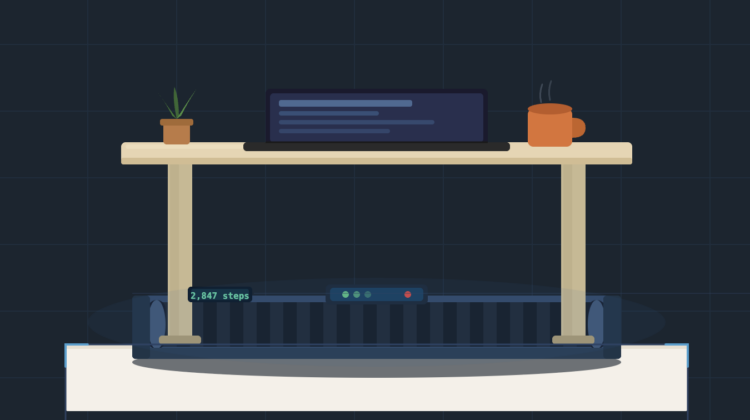
Sitting for eight hours and then going to the gym is not the same as moving throughout the day. Walking pads solve this problem quietly, cheaply, and more effectively than most people expect.
The average desk worker sits for somewhere between nine and eleven hours a day. This number includes the commute, the workday, the meals, and the evening wind-down, and it has been climbing steadily since remote work became normalized. The health implications are well documented and not subtle: prolonged sitting is associated with elevated cardiovascular risk, reduced insulin sensitivity, lower energy levels, and a higher risk of early mortality that is only partially offset by exercise.
That last part is the counterintuitive one. Thirty minutes of vigorous exercise does not cancel out eight hours of sitting. The research on this is fairly clear: the metabolic and cardiovascular risks of prolonged sedentary time operate somewhat independently of structured exercise. What protects you is not just the workout but the movement distributed throughout the day, the standing up, the walking around, the simple act of not being stationary for hours at a stretch.
This is the problem walking pads solve. Not by replacing your workout, but by making the hours between workouts dramatically less sedentary. A walking pace of one point five to two miles per hour is slow enough to type, read, and take calls without any meaningful loss of cognitive performance, and fast enough to add three to five miles of daily movement that would not otherwise happen. Over weeks and months, that compounds into something real.
The market for walking pads has expanded considerably in the last two years and the quality range is wide. Here is what to look for and which ones are actually worth buying.
What to Look for Before You Buy
Walking pads look similar in product photos and vary significantly in practice. The differences that matter most are not the ones that show up most prominently in marketing.
Belt width and length
This is the most important spec and the one most frequently undersized on budget models. A belt narrower than sixteen inches will feel constrictive for most adults and will require you to concentrate on staying centered in a way that defeats the purpose of working while walking. A belt shorter than forty inches creates a similar problem for anyone with a longer stride. Most people do not walk with a long stride at one and a half miles per hour, but shorter belts also create a psychological sensation of being cramped that adds up over an hour.
Look for at least sixteen inches wide and forty-five inches long as your baseline. Premium models go to twenty inches wide and fifty-five inches long, which feels meaningfully more natural.
Noise level
If you are taking video calls, which most remote workers do daily, the motor and belt noise of your walking pad will be audible to the people on the other end unless it is genuinely quiet. Budget models can run at fifty to sixty decibels, which is the equivalent of a normal conversation and absolutely will be picked up by a microphone. Quality models run at forty to forty-five decibels at walking speed, which is roughly the level of a quiet room and generally not noticeable on calls.
Noise levels in product listings are often provided at maximum speed, which is meaningless for walking pad use. If a brand quotes noise levels, ask or look for the rating at one to two miles per hour rather than the maximum.
Weight capacity and stability
Most walking pads are rated for two hundred and twenty to two hundred and sixty-five pounds. If you are near or above that range, the options narrow quickly and the cheaper models should be avoided entirely. A walking pad running at its weight limit will wear faster, run hotter, and is more likely to fail unpredictably. If weight capacity is a consideration, budget up rather than down.
Storage and portability
The folding versus non-folding distinction matters more than it seems if you live in a space where the walking pad cannot live permanently under a desk. Most walking pads fold in half for storage and can be stood vertically against a wall, which takes up roughly the footprint of a large suitcase. A few models go further and fold to a much smaller profile. If your living situation is tight, this is worth prioritizing over other features.
On desk heightA walking pad without a standing desk or a desk at the right height is only half a solution. The ideal desk height for walking while working is roughly elbow height when your arms are relaxed at your sides, which for most people is between forty and forty-four inches from the floor. A fixed-height desk in the standard twenty-nine to thirty inch range is too low for comfortable walking use. If you do not have a standing desk, a desk riser in the fifty to one hundred dollar range can bring a standard desk to the right height without requiring a full standing desk purchase.
The Best Walking Pads Right Now
Best overall
WalkingPad C2 / X21
WalkingPad is the brand that effectively created the consumer walking pad category and their mid-range models remain the benchmark against which most competitors are measured. The C2 is the entry point into their serious lineup and delivers on the things that matter most: a quiet motor at walking speed, a belt width of sixteen point five inches that feels genuinely comfortable, and a fold-flat design that stores easily under a couch or against a wall.
The X21 is the step-up model with a wider belt, a higher weight capacity of two hundred and sixty-five pounds, and slightly better build quality across the board. The price difference between the two is meaningful but the X21 is worth the extra spend for anyone who plans to use it daily rather than occasionally.
The companion app is functional rather than impressive, with basic tracking of steps, distance, and calories. The remote control that comes with both models is a better day-to-day interface than the app for simply adjusting speed while you work. The auto-speed mode, which adjusts pace based on your position on the belt, is a nice feature for light use but most people disable it and set a fixed speed.
The main limitation of both models is the maximum speed of three point seven miles per hour, which means they are designed specifically for walking rather than any kind of running. For the use case they are built for, this is irrelevant. If you want something that can also run, you need a different category of product entirely.
Price: $430 to $599
Belt: 16.5 inches wide
Noise: Very quiet
Weight limit: 220 to 265 lbs
Best budget pick
Urevo 2 in 1 Under Desk Treadmill
At around two hundred and fifty to two hundred and eighty dollars, the Urevo is the most capable walking pad available in the budget tier and the one that most consistently earns positive reviews from people who use it as a primary work-from-home tool rather than an occasional one.
The belt is fifteen point seven inches wide, which is slightly narrower than the WalkingPad models and does feel modestly more constrictive for people with wider stances. At slower walking speeds this is rarely an issue. The noise level is acceptable at one to two miles per hour, though noticeably louder than the WalkingPad at higher speeds. For call-heavy work schedules this is worth considering.
Where the Urevo earns its recommendation at this price point is build quality relative to the competition. The frame is solid, the belt does not slip or stutter at steady speeds, and the motor runs without the intermittent hesitation that shows up in cheaper alternatives. It also has a dual mode as both a walking pad and a more traditional treadmill with a folding handlebar, which some people value and others find unnecessary bulk.
The app is basic and the display panel is functional rather than attractive. Neither of these things affects how useful the product is for its core purpose. If you are not sure whether you will actually use a walking pad regularly and want to find out before committing more money, this is the right entry point.
Price: $250 to $280
Belt: 15.7 inches wide
Noise: Moderate
Weight limit: 265 lbs
Best premium option
Unsit Under Desk Treadmill by iMovR
The iMovR Unsit sits at the top of the walking pad market at around a thousand to twelve hundred dollars and justifies the price with a combination of belt width, noise level, and build quality that is genuinely different from anything in the mid-range. The belt is twenty inches wide and fifty-five inches long, which feels closer to a full-size treadmill than a walking pad and eliminates the cramped sensation entirely. At walking speed it is nearly silent, measured at around forty decibels, which is quiet enough to use on video calls without any concern.
The motor is rated for continuous use at a level the budget options are not designed for, which matters if you plan to walk for four to six hours a day rather than one or two. Lower-end motors running at high daily hours tend to degrade faster and run louder as they age. The iMovR is built for the person who is genuinely committing to this as a daily work setup rather than occasionally supplementing sedentary time.
The companion software integrates with standing desk controllers from iMovR and a handful of other brands, which is useful if you are building out a full sit-stand-walk workstation. For someone who is already invested in a quality home office setup and wants the best walking pad available without compromise, this is the answer. For everyone else, the WalkingPad X21 at half the price covers the ground that actually matters.
Price: $1,000 to $1,200
Belt: 20 inches wide
Noise: Exceptionally quiet
Weight limit: 350 lbs
Best compact option
Redliro Under Desk Treadmill
The Redliro sits between the Urevo and the WalkingPad in price and distinguishes itself primarily through its compact folded profile. At its smallest it folds to about seven inches tall, which means it slides under most standard sofas and beds in a way that the WalkingPad and Urevo do not quite manage. For apartment dwellers or anyone whose floor space is genuinely limited, this is the meaningful differentiator.
The belt at sixteen inches is comfortable enough, the motor is reasonably quiet at walking speeds, and the build quality is solid for the price point of around two hundred and ninety to three hundred and twenty dollars. It does not match the WalkingPad in any individual category but it holds its own across all of them while offering storage advantages none of the others match.
The display panel and controls are simple and functional. The weight capacity of two hundred and twenty pounds is on the lower end and worth checking carefully before purchasing. For anyone in a tight space who wants a capable walking pad that actually disappears when not in use, the Redliro is the most practical solution in the market.
Price: $290 to $320
Belt: 16 inches wide
Noise: Moderate to quiet
Weight limit: 220 lbs
What to Expect When You Start Using One
The first week on a walking pad feels slightly strange. Walking while reading or typing requires a small adjustment period where your body learns to do both simultaneously without one degrading the other. Most people find that reading is easier than typing for the first few days, and that typing catches up within a week as the movement becomes background rather than foreground.
The speed to aim for is lower than most people start with. One mile per hour feels almost comically slow when you first step on. One point five to two miles per hour is the sweet spot for sustained cognitive work: enough movement to meaningfully increase your daily step count and metabolic activity, slow enough that it becomes genuinely automatic within a few sessions. Three miles per hour and above starts to require attention that competes with focused work.
The goal is not to feel like you are exercising. The goal is to stop feeling like you have been sitting all day.
Fatigue builds more gradually than on a regular treadmill but it does build. Starting with sixty to ninety minutes per day and increasing over several weeks is more sustainable than trying to walk for four hours on day one. Feet and calves in particular need time to adjust to the sustained low-intensity load, especially if you use the walking pad in socks or light footwear. A supportive shoe makes a real difference for longer sessions.
Standing desk users have a significant advantage here because the desk height is already set correctly. If you are working with a desk riser on a standard desk, check the height carefully before your first session. Typing with your shoulders raised because the surface is too high will produce neck and shoulder discomfort that gets attributed to the walking pad when the real issue is the ergonomics.
The Honest Case for Buying One
Walking pads are not magic. They will not replace strength training, cardiovascular exercise, or the other components of a complete fitness approach. What they do is address a specific and real problem that most remote workers have, which is that the design of their workday produces an amount of sedentary time that even a good exercise routine does not fully offset.
Adding two to four miles of walking to a workday that would otherwise involve almost none of it is a meaningful health intervention. The research on low-intensity sustained movement, NEAT, or non-exercise activity thermogenesis, is consistent in showing benefits for metabolic health, cardiovascular risk, energy levels, and mood that are independent of and additive to structured exercise. A walking pad is one of the most practical ways to achieve this for someone whose work happens at a desk.
The people who get the most out of walking pads are the ones who use them consistently for the kinds of work that do not require deep focus: emails, light reading, routine calls, administrative tasks. The ones who get the least out of them are the ones who try to use them for everything including focused writing and complex analytical work, where the split attention genuinely does degrade performance, and who then conclude that walking pads do not work rather than that they are using them for the wrong tasks.
Used in its proper lane, a walking pad is one of the better quality of life purchases available for remote workers. The price is reasonable relative to what it costs to not address the problem, the space requirement is manageable, and the benefit shows up quickly enough to reinforce the habit before novelty fades. At the right price point for your situation and usage, it is worth it.