
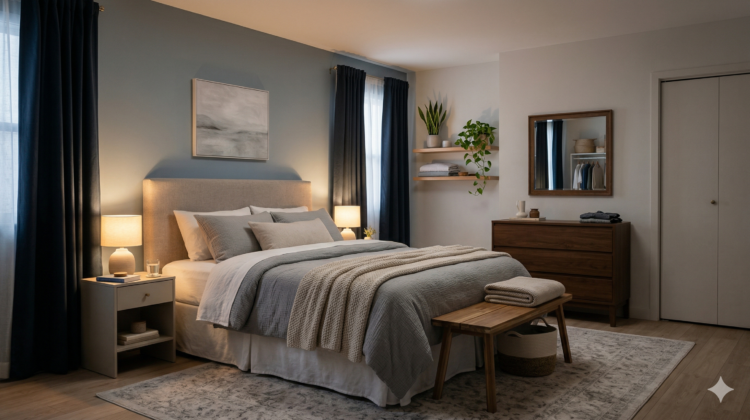
There is a version of sleep advice you have probably read a dozen times. Stop using your phone an hour before bed. Keep a consistent schedule. Avoid caffeine after two in the afternoon. Go for a walk in the morning. All of this is basically correct and most people already know it, which is why it tends to be the first thing they try and also why it tends to only partially work.
What gets far less attention is the room itself. The physical environment where you spend a third of your life, and whether that environment is actually set up to support sleep or just sort of tolerates it.
The research on sleep environment is not new and it is not subtle. Light, temperature, sound, and the psychological associations you have built with the space all have measurable effects on sleep quality that are independent of your habits and your stress levels. Fixing them does not require a renovation or an expensive mattress. Most of it requires fairly small changes that most people have never thought to make because nobody told them to look there.
Light: The Variable Most People Get Wrong
Your body’s sleep-wake cycle runs on light. Specifically, it runs on the presence or absence of blue-wavelength light, which is the signal your brain uses to calibrate what time of day it is. In the morning, blue light suppresses melatonin and raises alertness. In the evening, the absence of blue light triggers melatonin production and begins the process of winding down toward sleep.
The problem is that most bedrooms are full of blue light well into the evening. Overhead lighting, phone screens, and television all emit significant amounts of it. Your brain cannot tell the difference between noon sunlight and the blue-rich light from a bedside lamp at ten at night. Both read as daytime. Both delay the onset of melatonin. Both push your actual sleep onset later than you intend, even if you are lying in bed with your eyes closed feeling frustrated about not being able to fall asleep.
What to actually do about it
In the two hours before bed, light sources in the bedroom should ideally be warm in color temperature, meaning they trend toward orange and amber rather than white and blue. The number to know is 2700 Kelvin or below. Most smart bulbs allow you to set this and automate it on a schedule, which removes the need to remember. A lamp on a timer that shifts to warm light at nine every night costs almost nothing once set up and works without any ongoing effort from you.
Blackout curtains deserve more credit than they usually get. Street lights, car headlights, and the general ambient glow of a city or suburb create a persistent low-level light exposure throughout the night that disrupts the later sleep stages even when you are not conscious of it. A bedroom that is genuinely dark when the lights are off sleeps differently than one where you can make out objects clearly at midnight. If you have never slept in truly complete darkness, the difference in how rested you feel in the morning can be startling.
The tape testStand in your bedroom at midnight and note how much you can see without turning on a light. If you can read a clock on the wall or see your furniture clearly, your room is too bright for optimal sleep. A piece of black electrical tape over any LED indicators on devices is free. Blackout curtains or a well-fitted sleep mask handle the rest.
Temperature: The Number Most People Have Never Looked Up
Sleep researchers have studied thermal environment extensively, and there is a fairly clear consensus on what the optimal bedroom temperature looks like for most adults: somewhere between 65 and 68 degrees Fahrenheit, or 18 to 20 degrees Celsius. This is cooler than most people keep their homes during the day, and considerably cooler than most people’s intuition about what a comfortable sleeping temperature feels like.
The reason for the lower temperature is physiological. As you fall asleep, your core body temperature drops by one to two degrees. This drop is not just a side effect of sleep, it is part of the mechanism that initiates it. A cool room facilitates that drop. A warm room fights it. Sleeping in a room that is too warm means your body is working against its own sleep process for the entire night, which tends to manifest as lighter sleep, more frequent waking, and the feeling of never quite being fully rested even after a full eight hours.
This one is worth taking seriously even if it means a minor disagreement with a partner about the thermostat. The data on sleep temperature is unusually consistent, and the fix, turning the temperature down a few degrees before bed, is about as close to a free sleep improvement as exists.
If you share a bed with someone who runs cold
A cooler room does not have to mean a cold bed. Heavier blankets, a heated mattress pad, or simply a warmer set of pajamas solve the individual temperature problem without raising the room temperature. Dual-zone mattress toppers have become genuinely good in the last few years and are worth looking at if temperature disagreement is a recurring issue.
Sound: What You’re Probably Ignoring
Most people believe they have adapted to the noise in their sleeping environment. City dwellers especially will say they no longer hear the traffic or the neighbors or the elevator. This is true in one limited sense: you stop consciously registering sounds you hear every night. But your nervous system does not stop registering them. Every significant noise triggers a micro-arousal in the brain, a brief spike in alertness that rarely wakes you fully but does pull you out of deep sleep and back into lighter stages. Over the course of a night, these add up.
The most effective solution to variable nighttime noise is not silence but consistent sound. White noise, pink noise, or brown noise work by raising the ambient sound floor of the room to a level where intermittent sounds represent a smaller relative change. A car door slamming outside goes from being a dramatic intrusion into quiet to being a minor blip against a consistent background. The brain habituates to consistent sound readily; it never habituates to unpredictable sound.
The goal is not a silent room. The goal is a consistent room.
A dedicated white noise machine handles this more reliably than a phone playing an app, which is subject to notifications, battery anxiety, and the general psychological weight of having your phone in the room at all. The Lectrofan and the LectroFan Evo are the machines that come up most often in this context, and for good reason: they generate actual sound rather than looping recordings, which means there is no detectable pattern for the brain to track and eventually tune out.
For people in genuinely loud environments, well-fitted foam earplugs are underrated. They are not comfortable for everyone and take some adjustment, but for a light sleeper in a noisy city apartment, a pair of Mack’s or Howard Leight earplugs costs three dollars and solves the problem more completely than any machine.
Clutter and the Psychology of the Space
This one is harder to quantify than light or temperature, but the evidence and the reported experience are consistent enough to take seriously. Clutter in a bedroom creates a low-level cognitive load that does not switch off when you close your eyes. Visual reminders of tasks undone, decisions deferred, and things out of place keep a part of the brain in a mild state of activation that is antagonistic to the full mental release that deep sleep requires.
A 2015 study from St. Lawrence University found that people who described their bedrooms as cluttered had significantly more difficulty falling asleep and reported worse sleep quality than those who described their bedrooms as restful and organized. The mechanism is thought to be cortisol: clutter is a low-grade stressor, and elevated cortisol at bedtime reliably delays sleep onset and reduces the proportion of time spent in restorative slow-wave sleep.
The fix is not a perfectly minimalist room. It is a room that feels like it belongs to sleep rather than to the rest of your life. Laundry sorted or at least contained. Work items out of sight if not out of the room entirely. Surfaces clear enough that the visual field of the room communicates rest rather than backlog.
This is also why having a desk in the bedroom tends to be worse for sleep than most people expect. The desk does not need to be in use for it to activate associations with work and obligation. Its presence alone is enough. If you work from home and the desk has to be in the bedroom, a room divider or a curtain that physically separates the work zone from the sleep zone makes a real difference.
The Bed Itself
Mattress recommendations are their own rabbit hole and we are not going to go all the way down it here. But a few things are worth saying plainly.
A mattress that is more than eight years old is almost certainly not performing the way it was when it was new. Materials compress and degrade in ways that are not always visible from the outside, and the support profile of an old mattress tends to have shifted significantly from its original design. If yours is in this category and you have been sleeping poorly, the mattress is a more likely culprit than most of the behavioral adjustments people make first.
Pillows degrade faster than mattresses and get replaced less often. The average pillow should be replaced every one to two years. Most people use the same pillow for considerably longer than that. A pillow that no longer holds its shape through the night means your neck is in an unsupported position for hours at a time, which contributes to both sleep disruption and the kind of morning stiffness that gets attributed to age when it is really just equipment failure.
Bedding material affects temperature regulation more than most people realize. Synthetic fills trap heat. Natural fills, particularly down and wool, breathe better and regulate temperature more dynamically over the course of the night. If you tend to wake up hot in the second half of the night, the duvet is often the first thing worth changing before anything more expensive.
The One Thing That Ties All of It Together
Across all of these variables, light and temperature and sound and clutter and bedding, the underlying principle is the same. Your brain is constantly reading its environment for signals about what state it should be in. A bright, warm, noisy, cluttered room sends signals that are incompatible with deep sleep regardless of how tired you are or how disciplined your pre-bed routine has become. A dark, cool, quiet, visually calm room sends the opposite signals, and your nervous system responds accordingly.
None of these changes require spending a lot of money. Blackout curtains are forty dollars. A thermostat adjustment is free. A white noise machine is thirty. Clearing the surfaces in your bedroom takes an afternoon. The ceiling on the improvement is genuinely high relative to the investment, which is unusual in the world of sleep products where expensive solutions tend to have modest effects.
The bedroom is a tool. Most people have never thought to calibrate it.
Start with the thing that seems most obviously wrong in your room right now. The light that is too bright, the temperature that is too warm, the pile of things on the chair in the corner that has been there for three months. Fix that one thing and sleep in it for a week before adding anything else. The changes tend to be noticeable faster than you expect, and the cumulative effect of getting all of them right is the kind of sleep that makes you wonder what you were tolerating before.
Where to Start Shopping
If you want to address the biggest variables without overthinking it, here is a short list of things that have real evidence behind them and reasonable price points.
Blackout curtains: The NICETOWN blackout curtains are the standard recommendation at the budget end and genuinely work. For something more attractive, the Deconovo and the RYB Home options are both good and sit in the thirty to sixty dollar range per panel. Look for a triple-weave construction and check reviews specifically for light-blocking rather than just thermal performance.
White noise machine: The Lectrofan Classic is the benchmark. It produces non-looping sound, has a range of noise colors to try, and is small enough to travel with. The Dreamegg D1 is a slightly cheaper alternative with similar performance. Avoid anything that uses looping recordings rather than generating sound continuously.
Smart bulbs for warm light: The Philips Hue and LIFX bulbs both allow precise color temperature control and can be put on schedules. If you only want one bulb for a bedside lamp, the basic Philips Hue White Ambiance is more than enough. Set it to 2200 Kelvin after eight and leave it there.
Pillow: The Coop Home Goods adjustable pillow is the most consistently recommended option across sleep communities because the fill can be added or removed to dial in the exact loft you need. It is also washable, which matters more than most pillow marketing acknowledges.
None of these are necessary to start improving your sleep environment. The thermostat adjustment and the electrical tape cost nothing. But if you are going to spend money somewhere in your bedroom, these are the places where the return tends to justify it.