
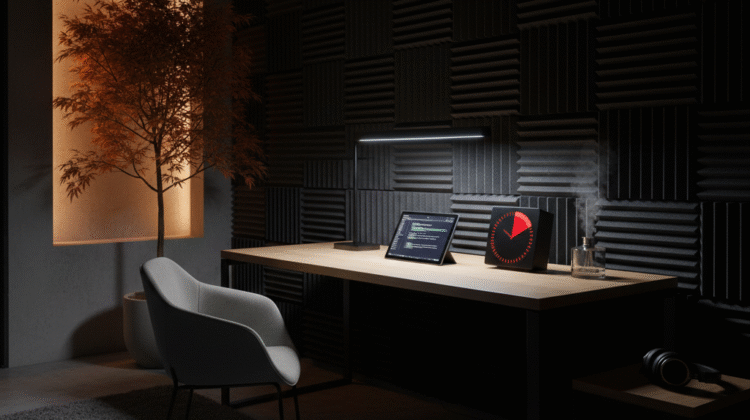
By 2026, the concept of the “home office” has become a relic of the early remote-work era. The standard setup—a desk, a task chair, and a monitor—is increasingly viewed as a bottleneck to high-level output. In its place, the global elite have pioneered the Cognitive Studio. This is a space designed not just for comfort, but for neuro-architecture: the practice of using physical environments to trigger specific mental states and protect the brain’s most valuable resource—deep, uninterrupted focus.
For the modern professional, the goal is to eliminate “Context Residue,” the mental lag that occurs when you switch from a creative task to an administrative one in the same physical environment. Here is how to build a studio that functions as an external hard drive for your intellect.
1. Zoning: The End of the Multipurpose Desk
The most significant flaw in traditional office design is the assumption that all work should happen in one chair. In a Cognitive Studio, the room is divided into “Mental Zones.”
- The Deep Work Bunker: A dedicated “High-Focus” station. This area is stripped of all visual clutter. The lighting is directional and blue-enriched to promote alertness. There is no second monitor here to tempt you with Slack or email; just one screen, one task, and total immersion.
- The Ideation Gallery: An analog space for “Wide Thinking.” This might include a floor-to-ceiling whiteboard, a standing height table, or a simple lounge chair with a view of nature. Movement is essential for creativity, and this zone encourages standing, pacing, and sketching without the rigid constraints of a keyboard.
2. Sensory Gating and Neural Priming
High-performance professionals in 2026 use sensory cues to “gate” their attention. This involves using specific smells and sounds to signal to the nervous system that it is time to perform.
The Olfactory Trigger: Use a specific, high-quality essential oil—such as cedarwood or hinoki—exclusively during deep work sessions. Over time, the brain forms a Pavlovian response to the scent, instantly lowering the threshold for entering a flow state.
The Sonic Cocoon: Move beyond generic “lo-fi beats.” The Cognitive Studio utilizes spatial audio and pink noise to mask environmental distractions. By using open-back headphones or high-end studio monitors, you create a 360-degree acoustic environment that “buffers” your concentration from the outside world.
3. The Biophilic Advantage: More Than Just Plants
Biophilic design is often misunderstood as simply “adding a plant.” In 2026, it is used as a tool for “Attention Restoration.” Research into Attention Restoration Theory (ART) suggests that looking at natural patterns—known as fractals—allows the prefrontal cortex to recover from the fatigue of analytical tasks.
The Implementation: Position your primary focus away from a window, but ensure a “micro-view” of nature is accessible during breaks. A single, large-scale Japanese Maple or a sophisticated terrarium provides the necessary visual complexity to reset your focus without providing the distraction of a busy street view.
4. Hardware for the Distraction-Free Mind
As software becomes more intrusive, the “Hardware Stack” of the Cognitive Studio has pivoted toward minimalist, single-use devices.
| Tool | Function | Why it Matters |
| E-Ink Tablet | Focused Writing/Reading | Eliminates blue light and notification pings. |
| Mechanical Time-Blocker | Analog Pacing | A physical clock that visualizes the “block” of time remaining. |
| Variable Lighting System | Circadian Syncing | Automatically shifts from cool light (AM) to amber (PM). |
| Vertical Mouse | Nerve Protection | Reduces the physical “background noise” of carpal strain. |
5. Lighting as a Cognitive Switch
The color temperature of your studio is the primary driver of your circadian rhythm and cortisol levels. A Cognitive Studio utilizes “Mode-Based Lighting.”
During the first four hours of the workday, the space should be flooded with high-intensity, 5000K light to suppress melatonin and sharpen analytical processing. As the day progresses into “Strategic Review” or “Creative Synthesis,” the lighting should drop to 2700K and move to a lower physical height—using floor lamps rather than ceiling lights—to signal the brain to move into a reflective, more expansive state of mind.
The Comgrove Verdict
In the intellectual economy of 2026, the person who can focus the longest wins. The Cognitive Studio is no longer a luxury; it is the fundamental infrastructure for anyone whose primary output is high-stakes decision-making or creative innovation. By designing for your biology rather than just your body, you transform your workspace into a powerful engine for intellectual flow.